Tuesday, October 15, 2013

Mixing Scotch or: How to Play Well with Others

There's a stigma involved with the mixing of Scotch in cocktails.  The idea is that it's just too good to adulterate with anything else.  Now, I'm as much a fan of Scotch as the next guy, if not more so.  However, I think you miss out on some fantastic possibilities if you don't let your Scotch play with its other friends in the liquor cabinet.  So, in the spirit of playing well with others, I experimented with mixing one of my favorite whiskeys with a great Scotch.


I chose a nice blended Scotch that wasn't too peaty and a bold, spicy, Rye that would be strong enough to dance with the Scotch without being overwhelmed.  A little cinnamon syrup and coffee bitters round out the drink.  A twist of orange as a garnish lights up the cocktail and adds aromatics.


This is certainly not something that you can only do with these two drinks.  Pairing different whisk(e)y is an art form.  Some distilleries have mastered it, or at least gotten pretty darn good at it.  For some examples, check out these blends:

http://www.corsairartisan.com/triple_smoke.html
http://www.highwest.com/spirits/new-campfire/

"An Unwritten Life"

1 oz. High West Rendezvous Rye
1 oz. Great King St.
1/4 oz. Cinnamon Simple Syrup (see previous posts)
1-3 dsh. Coffee Bitters (see previous posts)


Tuesday, October 8, 2013

Apple Manhattan (or: What to Do with a Lot of Bad Bourbon)

I've recently had a lot of bad bourbon on my hands.  As I've hinted at in previous posts, I'm working on barrel aging cocktails.  For this to happen, I had to prime the barrels - one with bourbon and one with port.  Being the poor grad student that I am, I'm not dropping a ton of $ on bourbon just for the sake of flavoring a barrel.  So, I got 2.5 liters of Very Old Barton and 2.5 liters of that very cheap port that they make somewhere in the US (hence not Porto) that's generally reserved for cooking.  After two weeks in my adorable charred oak barrels, I now have an overabundance of both.


Now, if you know me well you know that having a lot of an ingredient that kinda of sucks is a de facto challenge of my culinary/drink making skills.  So, Very Old Barton, CHALLENGE ACCEPTED.


There are a number of cocktails that are essentially pillars of the drinking community and that serve as the basis for a number of variations.  The Old Fashioned, the Martini, the Negroni, the Daiquiri, and of course, the Manhattan.  So, sticking with something tried and true, I decided to channel the regal Manhattan.  I started with 1.5 oz of the Very Old Barton, .5 oz of sweet vermouth (not pictured for some reason), and bitters.  Coffee bitters were my first choice and worked pretty well, though Angostura is also a natural pairing with the apple.  Peychaud's wasn't bad, either, but the other two were better. Next, I went for an apple because I had a bunch in my fridge.  I'm nothing if not economical (read as: lazy).  I took half the apple, cut it up sans skin, and muddled it in a shaker.  At this point I thought I'd throw in some simple syrup to maybe mask the nastiness of the bourbon.  I used a cinnamon* variety I made recently, about .25 ounce.  I then added the other ingredients and shook with ice.  Double strained (hawthorne and tea strainers) into a martini glass.  Finally, garnished with a slice of apple because this is a classy establishment.  At least on Tuesdays.


1.5 bourbon (Can be scaled up)
.5 oz sweet vermouth
1/2 a small(ish) apple, muddled (I'd recommend a sweeter apple like Golden Delicious to go with the vermouth)
.25 oz cinnamon simple syrup
Garnish with apple slice

OPTIONAL: dash of Cognac.  I've tried it with it and without it and it honestly wasn't too different.  Slightly smoother.  I think a half and half of Cognac and bourbon would be great here, but I'm trying to burn the bad bourbon, not the Cognac.


I was pleasantly surprised how well this turned out.  Very fresh, very smooth.  You get a lot of apple and a lot of spice.  Not overly sweet at all.  Fresh apple juice from muddling the fruit does wonders over using a processed substitute.  Perfect seasonal drink that costs a pittance to make.  Tastes even better with Aziz Ansari in the background.


*To make your own cinnamon simple syrup, just make a 1::1 simple syrup and simmer it with some cinnamon sticks in it for 30 minutes.  It lasts longer if you add a splash of rum or vodka.

P.S.  Barrel Aged Cocktails are coming soon.

Friday, October 4, 2013

Sterling's Gold

In honor of one of the greatest TV characters of all time, my boy Roger Sterling, I made a martini (ish thing) to go with my dinner.
Yes, the martini, one of the most abused and bastardized beverages in the world of booze.  These days it seems anything in a martini glass will be called a martini no matter how much blue curacao or sour apple schnapps you dump in it.  Even when you get closer to the heart of the drink, there is still dispute.      There's a segment of the drinking world that gets offended if you call a vodka martini a martini instead of a kangaroo.  I'm not that picky.  If it's got a few ounces of gin or vodka (maybe both, Mr. Bond), a little vermouth, and maybe a dash of bitters, I'm a happy camper.  Tonight I was feeling feisty, though, so I went a little crazy.  Okay, not too crazy, but definitely something a little different.


 I started with my go-to vodka, 42 Below.  Yeah, there's better stuff out there like Tito's, but for the price point and as low on the alcohol chain as vodka is for me, 42 Below is perfect.  For my vermouth, I added Cocchi Americano.  It's technically a fortified wine, but it acts like a vermouth.  It's also on the sweeter side and I normally stick with dry vermouth for a vodka martini.  However, like I said, feeling feisty.  My last ingredient was a few dashes of some black peppercorn bitters I recently made (see previous posts for a general bitters recipe).  Combine, stir with ice, and pour into a chilled martini glass.  Finished with a garnish of jalapeno pepper slices.

I hope Roger, would be proud.  Yeah, yeah, it's not exactly gold in the picture, but it does have a gold tint in real life, my phone's camera just sucks.  I also had to go with a clear spirits because that's how Roger roles.

3 oz Vodka
1/4 oz Cocchi Americano
3 dashes peppercorn bitters
Garnish with jalapeno slices


The pepper really comes out strong with this one.  It plays really well with the Cocchi in a way that I didn't exactly expect.  The mild sweetness of the vermouth is subtle and melts into the peppery bite at the end.  Not a bad way to enjoy a Braves game.


Tuesday, September 24, 2013

Harkening in the Beginning of Fall

Normally I save really unique and innovative stuff for this blog, but I just made a fantastic drink that I feel deserves being shared.  It's nothing flashy or overly complicated but I think it's a great way to get into the mood for Fall.

1 oz Redemption Rye (don't use a 100 proof rye like Rittenhouse, but a substitute is okay)
1 oz Amer Picon
1/2 oz St. Germain
2 dashes angostura bitters
1 cinnamon stick


Stir with ice.  Burn the tip of the cinnamon stick, catching all the smoke in a chilled rocks glass.  Add an ice sphere or large piece of ice.  Pour the drink over the ice and serve.


This is one of the best drinks I've ever made.  Dark chocolate, cinnamon, cardamom, orange, a little pear, and a whole lot of smooth  Sadly, you can't buy all the ingredients on one continent, but oh well.  I'm enjoying the bejeezus out of it right now. I'll worry about remaking it later.

Here's to the changing seasons.

Prosit!

Friday, September 20, 2013

Infusing Spirits

Today I play with my isi whipper a little more.  This time I'm infusing spirits.  Specifically, I'm infusing a nice reposado tequila with cilantro then making an Oaxaca Old Fashioned.  I'm going to throw the spirits and herbs into the whipper and inject it with NO2.  The process of nitrogen cavitation will quickly infuse the herbal flavors into the booze.  And by quick I mean literally 1 minute.  No storing stuff in a jar for two months.


2 oz reposado tequila
3/4 oz mezcal 
1/4 oz agave nectar
3 dashes falernum bitters (see previous posts)
Handful of fresh cilantro w/ larger stems removed


Start by pouring the spirits into the isi whipper.


Add a handful of cilantro.  Remove the bigger stems.  The nitrogen cavitation process really brings out the bitter flavors in the stem part, otherwise.  Whatever you're infusing, just be wary of the fact that it will bring out the flavor of whatever you put in there, so make sure whatever goes in is exactly what you want infused into your booze.  So basically watch out for stems and excessive pith, in general.


Add the NO2 charge, shake, lit sit for a minute, pour through a fine mesh strainer.  Then you just make the old fashioned from there.  Add all the ingredients, stir with ice, pour over a large ice sphere and garnish with a cilantro stem.


Nice, smokey, savory, and a healthy, herbal splash of cilantro.  Simple and fantastic for a Friday afternoon.

P.S. If you're not into buying expensive toys for booze like an isi whipper, a similar flavor can be achieved by gently muddling the cilantro in the mixing glass with the agave nectar before adding the booze and ice instead of infusing it.  Not quite as nice, in my opinion, but definitely not bad and worth trying.

P.P.S. I just bought two charred oak barrels for aging cocktails and spirits in.  I hope someone out there is as excited about this as I am.

Sunday, September 15, 2013

St. Germain Cocktail Foam (Alcoholic Whipped Cream)

Well, it's been too long.  I wish I had an excuse aside from laziness, but it's all I've got.  That being said, this post is all about cocktail foams, or as my friends have started calling it, "alcoholic whipped cream." Whatever you want to call it, it goes great on top of your drink or your waffle.

 To make a cocktail foam, you need an isi whipper (pictured below).  I realize this makes for a less-accessible drink, but it's a worthwhile investment if you like messing around in the kitchen as there are tons of cooking and/or drinking techniques you can utilize with it.


Anyways, your basic recipe will be 2 oz lemon juice, 2 gold gelatin sheets, 3 oz St. Germain, 4 oz egg whites, 6 oz 2::1 simple syrup (that's a 2 to 1 ratio of sugar to water).  Kathy Casey gets credit for this general recipe.  You'll then use two NO2 charges to inject into the whipper and start the emulsion process.

Begin by getting each ingredient prepared separately.  Start with the egg whites.  If you use actual eggs, make sure they're fresh and make sure you strain out any of the unsavory bits of the egg.  Using egg white mixture is much easier, but you can do either.  I've made it both ways and both turned out great.


 Fresh squeezed lemon juice.  Always go fresh, always strain.  Beehive juicer pictured.


Get 2 gold gelatin sheets.  Soak them in a bowl of ice cold water for 10 minutes.  Take them out and squeeze out any excess water.  They'll be gushy.   


Simple syrup is sugar water.  Nothing more.  You well usually see reference to the ratio of sugar to water.  Here, I use a 2:1.  Also, in normal drinks, using better sugar like turbinado sugar is recommended, but here it's not as important.  Add the sugar to the water and heat it over medium to dissolve the sugar into the water.


Once you get everything ready, add the simple syrup and lemon juice to a pot.  Heat on medium for a couple minutes.  Add the St. Germain and gelatin sheets (once they're bloomed!) to the pan and stir until the sheets are dissolved.  DO NOT BOIL.  Once it's dissolved, remove from heat and let it cool for 10 minutes.  Then, add the egg whites.  If you don't wait for the mixture to cool first, you will scramble eggs.  Mmmmmm.


Stir, and strain into the isi whipper.  I run it through a mesh strainer into a funnel for ease.  After it's all in (make sure you don't go past the fill line, which this recipe won't) charge the isi whipper twice with the NO2.  Shake thoroughly after each injection.  Chill for 5 hours or overnight.  


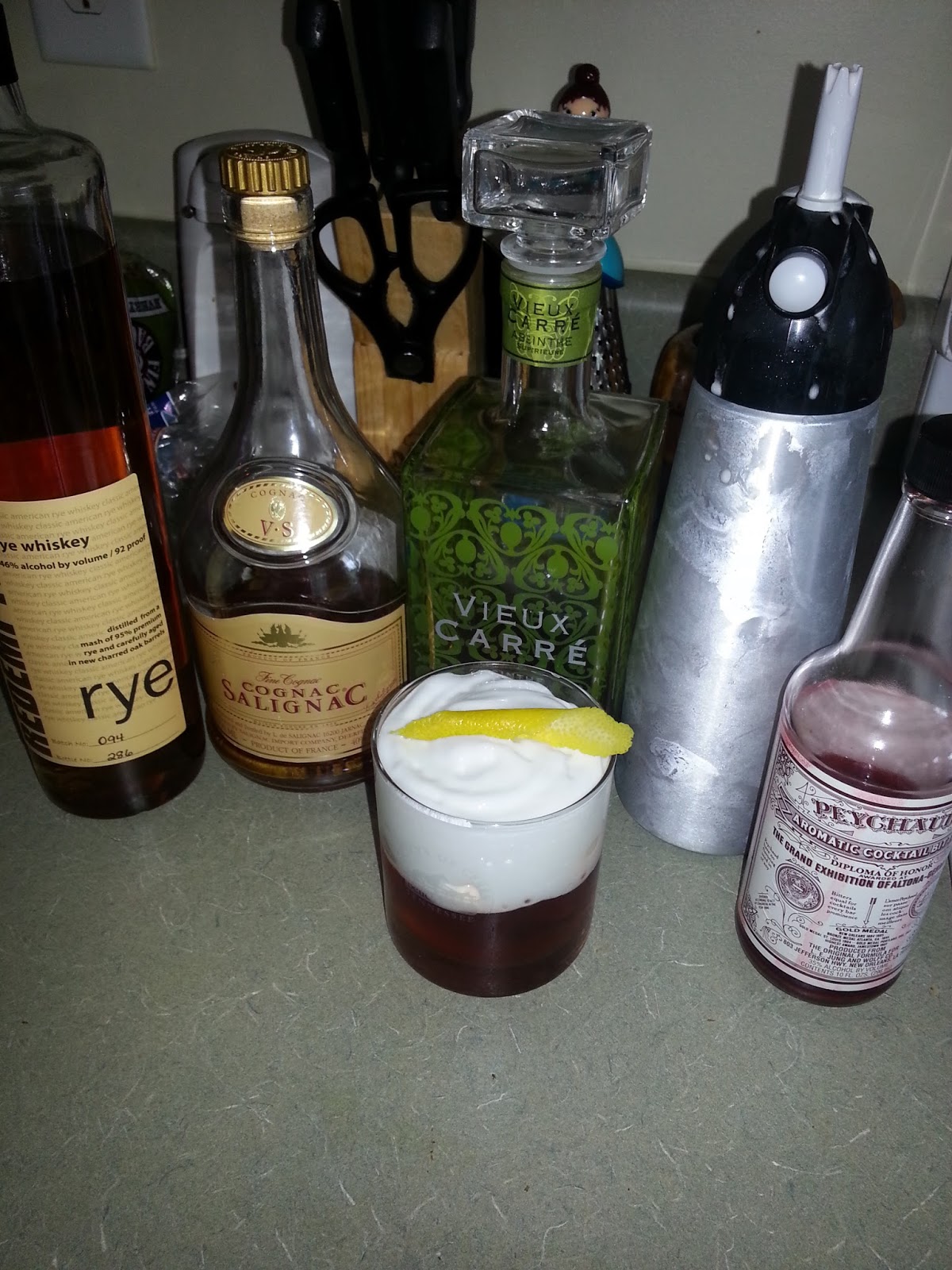
Once you have your St. Germain foam, you've got to use it!  I decided to try a few different variations.  First, I tried a modified Sazerac:

1 oz rye
1 oz Cognac
3 dash Peychaud's bitters 
1 dash absinthe
1 sugar cube
Juice of 1/2 a lemon
Garnish with lemon twist.

Do an absinthe rinse in a chilled class, add about 2 fingers of the foam, then add the rest of the cocktail over the foam.  If there is a hole, cover it with more foam.  Garnish with lemon.

This was good.  The normal Sazerac was too strong of a contrast so I added an old school Sazerac ingredient, Cognac, in place of half the rye to mellow it out.  Plus the juice of half a lemon.  Definitely a fun variation on the Sazerac, but not my favorite.  I'm also a purist, so I might be a little biased.  St. Germain, rye, and cognac do go well together, though. 


Next I tried something of a modified French 75 where I cut the gin entirely and used a half and half blend of Lillet Blanc and Cocchi Americano instead.

.75 oz Lillet Blanc
.75 oz Cocchi Americano
.5 oz 1::1 simple syrup
.5 oz  mango lemonade 
Champagne

Shake everything but the champagne with ice, pour into a champagne flute, top with champagne, but leave room for the St. Germain foam.  Garnish with grapefruit zest. 

This was nice.  Good brunch cocktail.  Very elegant.  The foam pairs naturally with pretty much everything here, except maybe the Cocchi, but it works well here.  Mango lemonade was used instead of lemon juice because I ran out of lemons.  Nice variation, but lemon worked great, too, when I got more.


Next on the list was a variation on a mezcal old fashioned.

2 oz mezcal reposado
.5 oz pomegranate raspberry tea simple syrup (see previous posts)
3 dashes falernum bitters (see previous posts)
Juice of half a lime

Shake with ice, pour over a large ice sphere, top with St Germain foam, garnish with an orange twist.  This was good, but the mezcal is just too potent.  It needed more juice to cut the mezcal.  Maybe the juice of half a grapefruit.  Something needs to bridge the gap between the mezcal and the St. Germain.


Finally I did a rum variation.  For some reason I forgot to take a picture of all the ingredients.  Sorry, my loyal two readers.  I really let you guys down, I know.

2 oz Crusoe Rum (brand matters here...the vanilla notes just work so well with the foam).
.5 oz pomegranate raspberry tea syrup (see previous posts)
3 dashes falernum bitters (see previous posts)
Juice of half a lime
Juice of half a grapefruit 

Shake with ice, top with St. Germain foam, garnish with fresh ground cinnamon.  This was the collective favorite of everyone who tried these, including myself.  Best blend of flavors.  Also, the cinnamon on top was a great addition.  This one's a keeper in my cocktail repertoire, for sure.


That's all for now, thanks for reading.  Next update will not take as long, I promise.  Either quick infusions via the isi whipper, new bitter experiments, or fat washing.  Haven't decided yet.

Saturday, June 15, 2013

Playing with Beer: Part I

Beer is typically something that people believe should stay the hell away from a cocktail.  If you don't know what you're doing, this is generally a good principle.  But generally good principles are meant to be broken - especially when you don't know what you're doing, like myself.  So, throwing caution to the wind, I'm going to outline the various and sundry beers I've met in Belgium and what I plan on doing with them in a cocktail.  Sadly I will not be able to post the results (for the most part) until I'm back in the States due to a lack of equipment.  I'll just make a "Part II," so be on the look out for that, oh faithful two readers.

Most of my beer adventuring has consisted of two main types of Belgian beer: Lambics and Trappist beer.

Jacked straight from Wikipedia:

"Lambic is a type of beer brewed traditionally in the Pajottenland region of Belgium (southwest of Brussels) and in Brussels itself at the Cantillon Brewery and museum. Lambic is now mainly consumed after refermentation, resulting in derived beers such as Gueuze or Kriek lambic.[1]
Unlike conventional ales and lagers, which are fermented by carefully cultivated strains of brewer's yeasts, lambic beer is produced by spontaneous fermentation: it is exposed to the wild yeasts and bacteria that are said to be native to the Senne valley, in which Brussels lies. It is this unusual process which gives the beer its distinctive flavour: dry, vinous, and cidery, usually with a sour aftertaste."
and
"Trappist beer is brewed by Trappist breweries. Eight monasteries — six in Belgium, one in the Netherlands and one in Austria — currently brew beer and sell it as Authentic Trappist Product. . . . In 1997, eight Trappist abbeys – six from Belgium (OrvalChimayWestvleterenRochefortWestmalle and Achel), one from the Netherlands (Koningshoeven) and one from Germany (Mariawald) – founded the International Trappist Association (ITA) to prevent non-Trappist commercial companies from abusing the Trappist name. This private association created a logo that is assigned to goods (cheese, beer, wine, etc.) that respect precise production criteria. For the beers, these criteria are the following:
  • The beer must be brewed within the walls of a Trappist monastery, either by the monks themselves or under their supervision.
  • The brewery must be of secondary importance within the monastery and it should witness to the business practices proper to a monastic way of life
  • The brewery is not intended to be a profit-making venture. The income covers the living expenses of the monks and the maintenance of the buildings and grounds. Whatever remains is donated to charity for social work and to help persons in need.
  • Trappist breweries are constantly monitored to assure the irreproachable quality of their beers.
This association has a legal standing, and its logo gives the consumer some information and guarantees about the product."

These two very different classifications include all of the most highly regarded Belgian beer, many of which happen to also be some of the best beers in the world, if not the best (Westvleteran 12, in some circles like RateBeer.com).

I happen to be living about 500 yards from the Cantillon Brewery/Museum so I've taken full advantage of that and sampled all of their currently available beers.  Most of the Trappist beers are readily available even in super markets here for very cheap prices.  Rochefort 10 (11.2% ABV and the 17th highest ranked beer on Beer Advocate, and most importantly my favorite beer) runs for 1.75 euro for a single 12 oz bottle at the overpriced Food Lion.  Some, like the Westvleterans, are not so easy to find and can only be purchased at the Abby or in a few other select locations based on availability.  So, basically I've had a field day trying all these wonderful brews for relatively cheap prices.  Now, I want to experiment with them.  Below, I'll list some of my favorites and then describe what I plan on doing with them.

Rochefort 10: 
As previously stated, this is my favorite beer.  It's very potent, dark, silky, chocolaty, and full of dark fruits.  If my heart weren't forever on the side of cocktails over beer, I would have a heard time doing anything with this but drinking it straight and unadulterated.  But I will forever and always favor the cocktail, so here it goes:
Trappist Old Fasioned
  • 2 oz rye whiskey
  • .25 oz Rochefort 10 syrup*
  • 1 dash of Angostura bitters
  • Cherry, Orange

Combine Rochefort 10 syrup with bitters, add rye and ice, stir.  Pour over large piece of ice in an old fashioned glass.  Garnish with orange twist and cherry.

*To make a syrup out of a beer, essentially you'll make a simple syrup with beer instead of water with an extra step of removing the carbonation.  Wait until Part II for more details.
If this one works, which I feel pretty good about, I'll get a little more creative.  Stay tuned.

Cantillon 100% Lambic Kriek Bio: 
This Cantillon is made by macerating fresh cherries in a blend of Lambics of various ages.  It's pretty amazing. Lambics are sour and come in a little bit like Champagne.  Kriek = cherry, by the way.  It's certainly over-simplifying such a great beer, but it's easy to think of this as a sour-cherry Champagne.   So, my first thought was to use this like Champagne in cocktails.  French 75 topped with Lambic Kriek or maybe a Lambic Kriek Mimosa (this one concerns me a little since Mimosas are typically best cold and Lambics are best warm, but we'll see)?
Belgian 75:
  • 1 oz gin
  • 1/2 oz. simple syrup (or 2 tsp. superfine sugar)
  • 1/2 oz. lemon juice
  • Cantillon 100% Lambic Kriek Bio

Combine gin, sugar, and lemon juice in a cocktail shaker filled with ice.  Shake vigorously and strain into an iced champagne glass.  Fill with the Lambic Kriek.  Garnish with a cherry in the bottom of the glass.
Kriek Mimosa
  • 1 part Cantill 100% Lambic Kriek Bio
  • 1 part orange juice

Mix ingredients into a champagne glass.  Garnish with a cherry.

Cantillon Iris: 
This is kind of a weird Cantillon because it's not technically a Lambic because they add hops.  This results in a beer that actually tastes like the normal beer most of us know and love.  I'll use this for Amer Biere (Amer Picon, a French orange aperitif, lemon syrup, and beer)
Amer Biere de Cantillon
  • 1 oz Amer Picon
  • 1/3 lemon syrup (simple syrup made with lemon juice instead of water)
  • Cantillon Iris

Add Amer Picon and lemon syrup to a glass. Add beer.  Stir.

I clearly have my work cut out for me.  Stay tuned for the sequel/results.  It could be great or hilariously horrible.  Maybe both?  Anyways, I should be back with an post about aperitifs and digestifs in the near future.  And in the somewhat near future, I'm going to try and make some cocktails for a bunch of French people in someone else's kitchen with al foreign booze.  THAT will be a funny blog post, I promise you.  Until then,

Prosit!